
Bath County Parole vs Probation
Parole and probation can both place a person in the community under conditions, but they arise from different authority. The Virginia Parole Board decides parole. A Bath court may impose probation in its sentencing order, including probation after a jail or prison term. VADOC Community Corrections carries out field supervision for both. None of these labels, by itself, means the whole sentence has ended.
| Point | Parole | Probation |
|---|---|---|
| Who creates it | The Virginia Parole Board grants conditional release in an eligible case. | A court places the person on probation through a sentencing or revocation order. |
| Custody link | It follows release from state confinement under Board authority. | It may follow confinement or be imposed without a state-prison stay. |
| Who supervises | VADOC Community Corrections through the assigned district office. | VADOC Community Corrections through the assigned district office. |
| Best source | Board decision plus VADOC status and actual release documentation. | Sentencing order plus VADOC supervisee status and office confirmation. |
| How it ends | Completion or formal discharge under the controlling authority. | Completion or discharge under the court order and supervision record. |
Check Bath County Post-Release Supervision
Verification works best as a sequence because the public sources do not answer the same question. The VADOC Inmate and Supervisee Locator can identify a correctional institution or a community-corrections placement. The court supplies the probation authority, while the Parole Board supplies parole decisions.
- Confirm the full name and VADOC number when known. A name-only match is not enough.
- Search the VADOC locator and read the location or status exactly. An institution points to custody; a district or supervision entry can point to community oversight.
- For probation, read the Bath sentencing order for the term, suspended time, and conditions the public order states.
- For parole, check the Virginia Parole Board monthly reports for the decision, then confirm the later operational status through VADOC.
- Use VADOC's office directory for the office serving the approved residence, not merely the county of conviction.
- Ask the office what status it may publicly confirm. Do not request protected case-plan, victim, medical, or family details.
Note: A Parole Board grant documents approval, while the VADOC record documents whether release and community placement later occurred.
A negative locator result does not prove final discharge. It can reflect spelling, scope, a data restriction, or a record that is no longer in the locator's public view. For the full local custody trail before supervision began, use the Bath County released-inmate search and records guide.
Bath County Supervision Office Route
A Bath conviction does not guarantee a Bath reporting location. VADOC assigns supervision around the approved residence, and a case can transfer. The official directory is therefore safer than guessing a district from a court location. The research identified VADOC District 40 material as a regional resource, but did not establish a single fixed Bath field office that applies to every supervisee.
Provide the full name and VADOC number if known. A district office entry supports current supervision, but it does not establish the earlier jail exit time or show that every sentence obligation has ended.
Bath County Violations and Absconder Status
Conditions are case-specific. Public orders or Board materials may refer to reporting, lawful conduct, residence approval, or other terms, but an office case plan can contain protected details. A missed report or alleged violation is not the same as a final revocation finding. The supervising agency and court record are the right places to separate an allegation from a decided result.
An absconder or warrant indicator means the person may face arrest for alleged noncompliance. It is not proof of successful discharge, and no official Bath County-specific public absconder list was found. Verify through VADOC Community Corrections or law enforcement. Do not approach or try to detain a person based on an online label.
Note: Virginia VINE tracks participating custody events, not the full life cycle of a probation or parole case.
How Bath County Supervision Ends
Physical release, the start of supervision, and final discharge should be read as separate dates. A Board grant shows a parole decision, not the moment the person walked out. A VADOC community-corrections result shows supervision rather than unconditional discharge. A court order can define probation, while the final agency or court record establishes when that obligation ended.
For a historical conclusion, request the record closest to the event. VADOC release papers may include an Order of Release and Conditions of Parole or Probation signed and dated by the person and a witness. The sentencing or later court order can show the judicial term. Ask VADOC for a discharge or supervision-status record when the public locator is silent. Do not convert an absent search result into a discharge date.
Keep the local jail event distinct as well. Alleghany Regional Jail can record that physical custody ended or shifted to another authority, but jail staff do not make the Parole Board’s decision and should not be asked to certify a later field-supervision term. Bath Combined Court handles the district-level trail for misdemeanors and preliminary felony matters, while Bath Circuit Court holds felony final dispositions and appeals. Search the court level that created the controlling order.
If the person was released from a VADOC institution, an actual-release notice can establish the end of state physical custody. It does not necessarily establish final discharge because parole or probation may begin at once. Conversely, completion of supervision does not rewrite the earlier release date. A sound timeline preserves both milestones and the agency responsible for each one.
Bath County Parole Decision Records
The Virginia Parole Board handles decisions, while VADOC handles release execution and supervision. Its public-meetings calendar lists upcoming meeting details and past minutes, but it is not a complete advance docket for every eligible person. Since July 2024, qualifying final deliberations and votes occur in public meetings, yet the Board explains that not every eligible person appears and names may be announced only at a meeting.
Monthly decision reports are more useful for a named historical check. They can show a DOC number, name, case type, decision and certification dates, result, reasons or conditions, conviction jurisdiction, offenses, sentence data, and member votes. Read the result literally. A grant is approval subject to certification, release planning, notices, detainers, and conditions. A denial, deferral, or rescission does not establish release.
Note: Public meeting listings are not a complete advance parole docket, so check monthly results and VADOC status together.
Ordinary discretionary parole was abolished for most Virginia felonies committed on or after January 1, 1995, though older cohorts and statutory exceptions remain. Eligibility under Virginia Code §53.1-151 depends on facts such as offense date, sentence structure, prior commitments, and exclusions. A conviction label alone is not enough to calculate it.
Administrative interviews add another stage. Board policy says eligible people generally receive a personal interview before eligibility absent reasonable cause, and review is organized into calendar quarters. VADOC supplies eligible names and locations, so no ordinary formal application is required. An interview or scheduled review proves consideration, not release. Pair it with the published decision and then with VADOC’s later custody status.
The image below comes from the Virginia Parole Board's official site and shows its navigation to decision and docket resources.
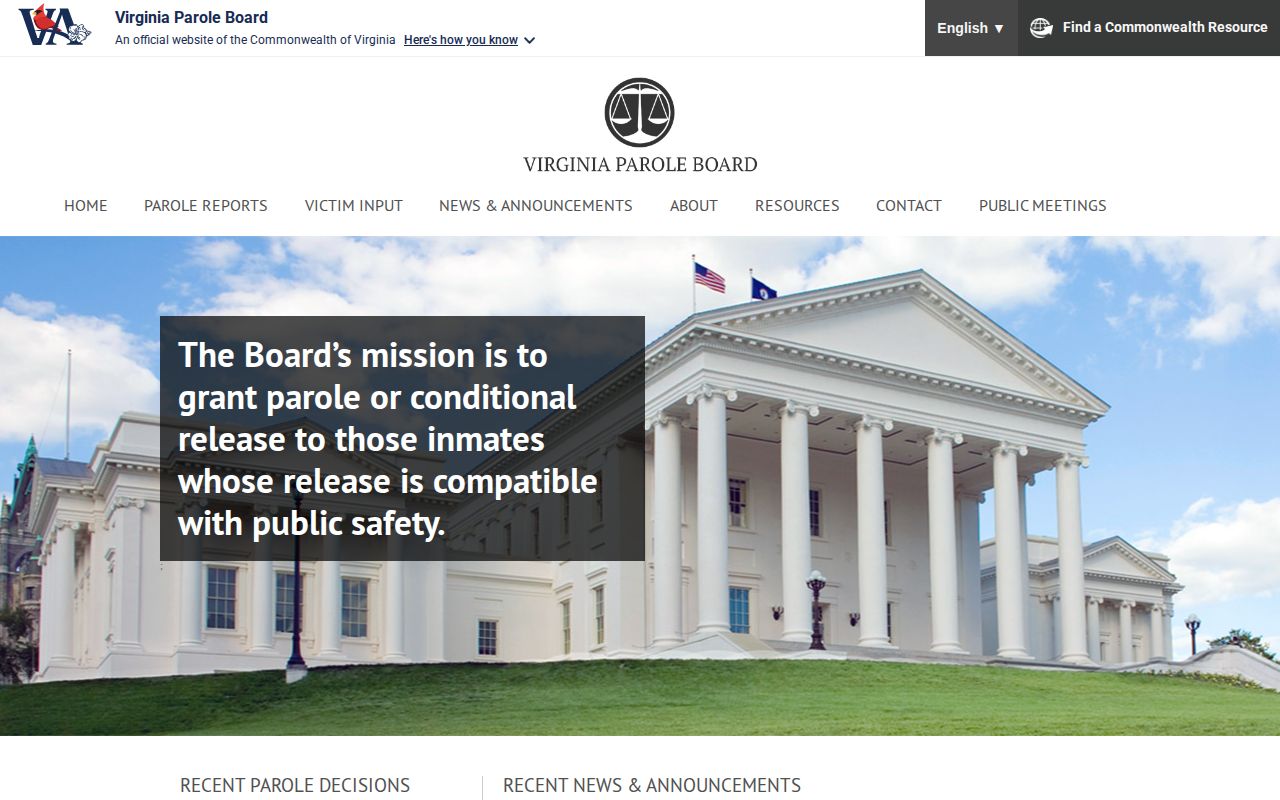
The Board source documents its own decision stage; VADOC status or release papers are still needed to confirm the later release and supervision stage.
Bath County Release and Reentry Navigation
VADOC District 40's resource directory names the Alleghany County Reentry Council and gives District40@vadoc.virginia.gov as a regional point of contact. That cross-county detail fits Bath because many local arrests route to Alleghany Regional Jail in Covington, while community services and supervision may span locality lines.
The council contact is a navigation resource after release. It is not proof that a named person left custody, qualified for a program, or completed supervision. Use a dated jail release record for an Alleghany exit and a VADOC record for state release or supervision. Keep those proof questions separate from service navigation.
Correcting a Bath County Release Record
A documented Alleghany release can still appear inconsistent with a person's criminal-history entry. Virginia Code §9.1-132 gives an individual a route to inspect their own Central Criminal Records Exchange or arresting-agency criminal-history information for completeness and accuracy, then begin a correction challenge under the governing rules.
This personal correction path does not alter a court order or replace VADOC supervision records. Compare the person, case, dates, and agency first. Supply the dated release or disposition record that supports the claimed error, and follow the official challenge process rather than assuming a roster disappearance proves the entry wrong.
When sources conflict, compare the event each one records. A Bath court order can state probation, the Board can decide parole, Alleghany Regional Jail can record a local exit or transfer, and VADOC can show a supervision placement. Dates can differ because those acts occur in sequence. Preserve each source’s label instead of selecting the earliest result and calling it final discharge.